
Authentic vs. Fake Moroccan Rugs: 7 Signs to Check Before You Buy
The Moroccan rug market is full of machine-loomed lookalikes made in factories nowhere near Morocco, sold with the same photography and the same buzzwords as the real thing. If you're paying handmade prices, you deserve to actually get a handmade rug. This guide walks through seven simple checks that separate an authentic handwoven Moroccan rug from a mass-produced imitation: how the back of the rug should look, why real hand-knotting is a little irregular on purpose, what genuine Mrirt wool feels like versus a synthetic blend, what natural dyes do that printed colour never can, what the fringe reveals, why price is a signal, and the paperwork a real workshop can always provide about who wove your rug and where.
The Moroccan rug market is full of machine-loomed lookalikes made in factories nowhere near Morocco, sold with the same photography and the same buzzwords as the real thing. If you are paying handmade prices, you deserve to actually get a handmade rug. Here are the seven checks we use whenever we walk into a shop, virtual or physical, that we do not know.
1. Turn the rug over
The back is where the truth lives. A real hand-knotted rug shows the knots on the reverse, slightly irregular, tight but not perfectly identical, with the pattern faintly readable from behind. A machine-loomed rug has a smooth or gridded backing that hides the knots entirely, or shows a suspiciously uniform mesh. If the back is glued to a canvas, walk away.
2. Look for on-purpose irregularity
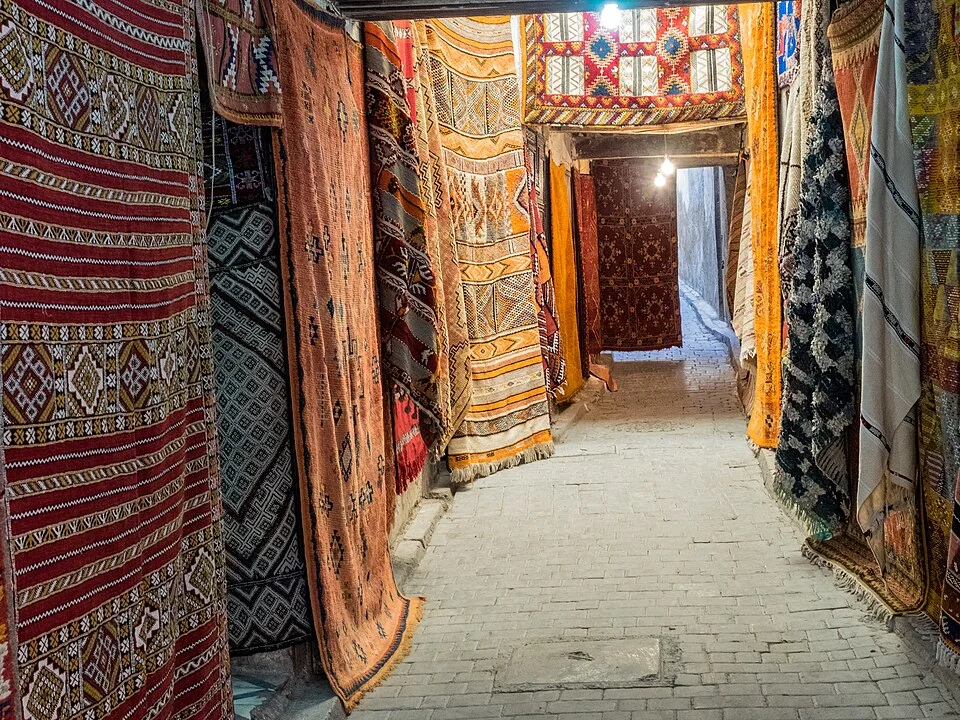
Real hand-knotting is a little uneven on purpose. A line that wavers, a border that widens a hair over a metre, a motif that shifts slightly, these are fingerprints, not flaws. Suspiciously perfect symmetry and pixel-clean edges are usually a sign of a machine.
3. Feel the wool
Genuine Mrirt wool feels dense, springy, slightly warm, and a little uneven in the yarn when you pinch a strand. Synthetic pile feels slicker, cooler, and unnaturally uniform. If a rug is described as wool blend or contains any percentage of polyester, viscose, or acrylic, it will not age like the wool piece it is imitating. More on why on our quality page.
4. Read the color
Natural dyes are never quite uniform. Turn a piece over and look at how the color pools across the back. Real natural dye reads slightly variable, warmer here, cooler there. Printed or synthetic dye reads flat and identical from one end to the other. Look at how the yarn takes light: natural dye deepens where the pile bends, printed color stays the same.
5. Study the fringe
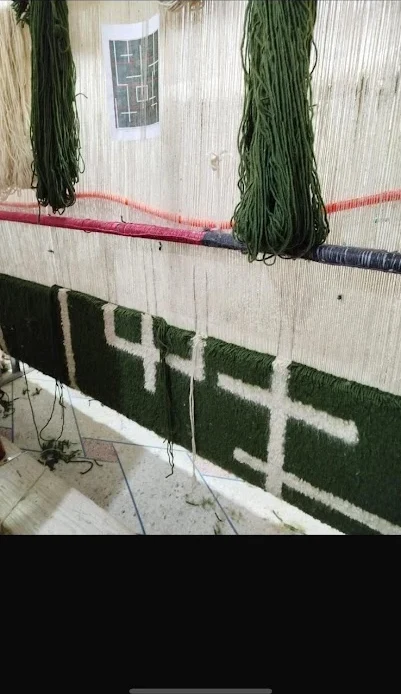
On a real hand-knotted rug, the fringe is an extension of the warp threads, meaning it is structurally part of the rug. On a machine-loomed piece, the fringe is often sewn on afterwards, and you can see the seam if you look closely. A stitched-on fringe is a giveaway that the rug was not made on an upright loom.
6. Take price seriously
A hand-knotted Moroccan rug takes an artisan weeks to months to make. A large piece in Mrirt takes sixteen to twenty-two weeks of one weaver's attention. If a rug that looks like ours costs a quarter of the price and ships in three days, it is not the same rug. Cheap rugs at scale exist because a machine is doing the work; someone still has to pay for the weaver's time, and if the price does not reflect that, the weaver did not do it.
7. Ask about the workshop
A real workshop can always tell you where the rug was made, roughly who made it, what wool was used, and how it was dyed. If a seller cannot answer any of that, treat the ambiguity as an answer in itself. Everything we sell traces back to a workshop we have been to, and we are happy to explain any of it, in FAQ form or by email through our contact page.
If a piece passes these seven checks, you are likely looking at the real thing. If you want a shortcut, our own collection is made entirely by hand in the Mrirt tradition, covered by our lifetime guarantee.