
The loom remembers
A made-to-order rug isn't manufactured, it's grown, row by row, on a wooden loom that has seen thousands like it.
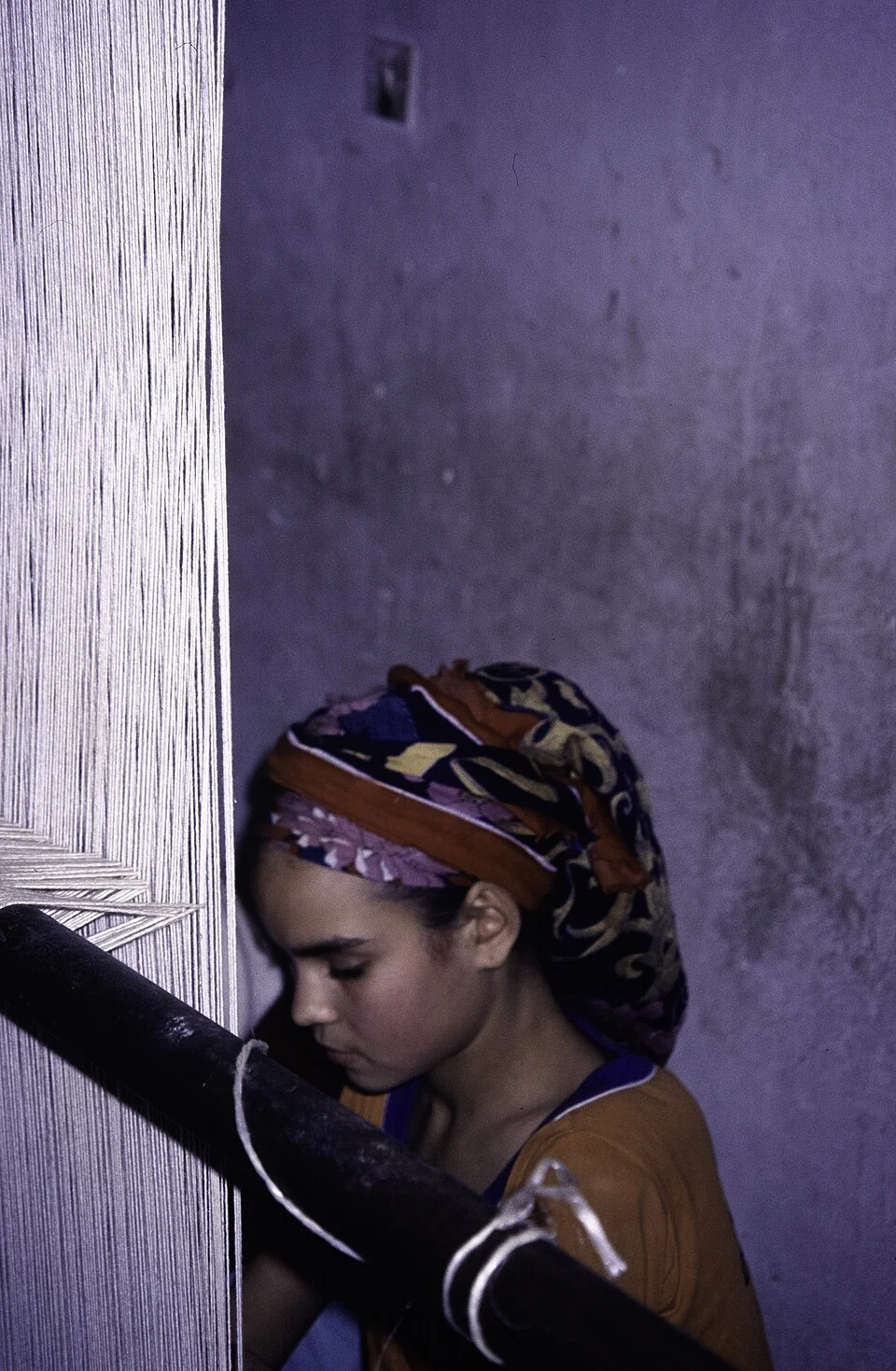
Walk into a weaving room above Mrirt and the first thing you notice is the quiet. Then, once your ears adjust, the rhythm: the soft beat of a heavy iron comb pressing each row of knots into place, one row at a time. It is a sound that has not changed for centuries, and if you close your eyes it could be almost any year of the last five hundred.
The loom itself is a wooden frame taller than the woman working at it. It leans against the wall of the workshop, warp threads stretched vertically top to bottom like the strings of an oversized harp. There is nothing digital about it, no motor, no pattern printed on a screen. Everything a weaver needs is either in her head or clipped to a paper card above her eyeline, and she consults the card the way a cook consults a recipe she has already half memorised.
A rug is grown, not manufactured
Our rugs are hand-knotted, one knot at a time. A small piece might take four weeks; a large one closer to five months. There is no machine version of this. Powered tufting guns exist, and produce something that looks like a rug from three metres away, but the resulting object has neither the density, the springiness, nor the lifespan of a hand-knotted piece. When we talk about knots per square metre on our craft page, we mean actual knots tied by actual hands, counted one by one.
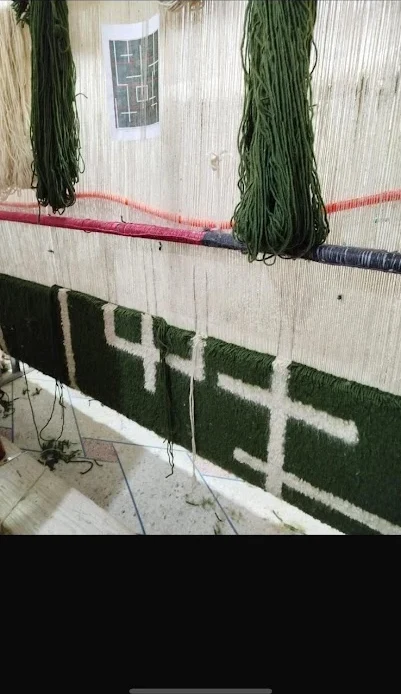
Because each rug is woven to order, no two are ever identical. The weaver makes hundreds of small decisions a day, on tension, on spacing, on where a motif begins and how far it travels before it turns. Those decisions are not deviations from a plan, they are the plan. They are what make your rug yours and no one else's, and they are why a rug made this way still looks like itself twenty years in.
The lineage of a piece of wood
We like to say the loom remembers. Every rug that has ever been made on it leaves the faintest trace, a slight worn place where the weaver leans, a smoothness where the shuttle passes. When your rug leaves the frame, another begins in exactly the same spot, and yours joins a lineage that runs back further than any of us has bothered to count.
If you want a rug that will not exist until you ask for it, our made-to-order approach is the whole point, and a custom commission takes the same idea one step further. Either way, what you receive was, for a season, the entire attention of one person.