
In her own time
A conversation with one of the weavers behind Azral, on patience, pattern, and the work she learned at her mother's side.
There is a moment we return to often, an afternoon early in our first year working in Morocco, sitting on a low bench in a weaver's workshop above Khenifra with mint tea going cold on the floor. We had come with questions we thought were sharp and left with almost none of them answered, and it was one of the most important afternoons in the making of Azral.
The room is quiet before the rug is
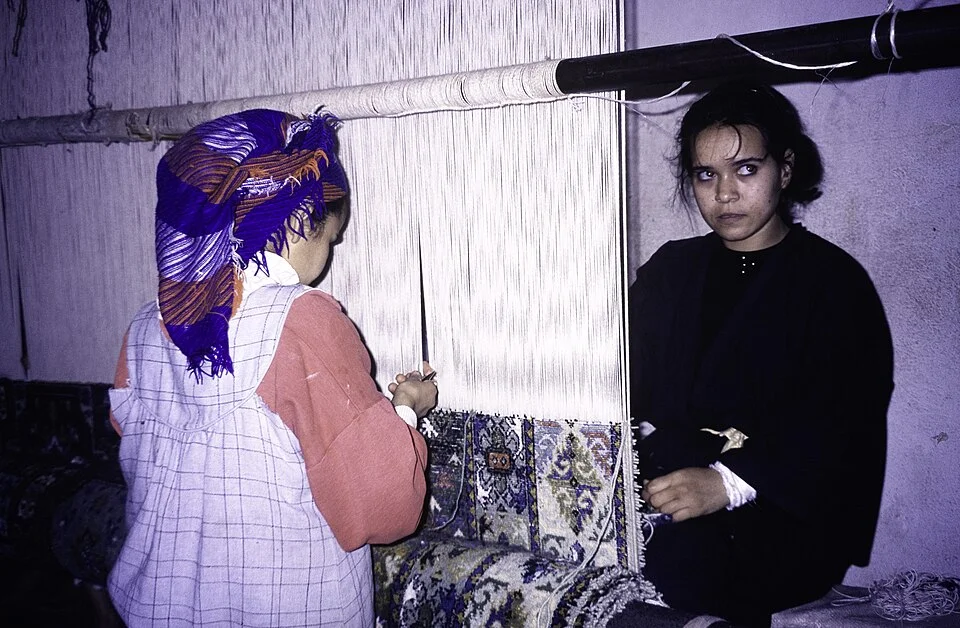
The workshop was two rooms cut into the ground floor of a stone house. In the first, two women were working side by side on the same loom, one a generation older than the other. Their hands moved in a rhythm we could not quite follow, a knot, a knot, a tightening pull, the comb, another knot. They did not look at their hands. They looked at the pattern card pinned above the loom, or at each other, or, when we said something particularly clumsy in Arabic, at us.
We asked the older weaver how long it had taken her to learn. She smiled and said she was still learning, and then, after a pause, that she had first sat at her mother's side at seven. She was now sixty-one. We did the math out loud without meaning to and she laughed at us gently. Time is not the measure here. Attention is. She had spent fifty-four years paying the same kind of attention, every day, to the same slow act, and this was why she could work without looking.
Patience is a technique
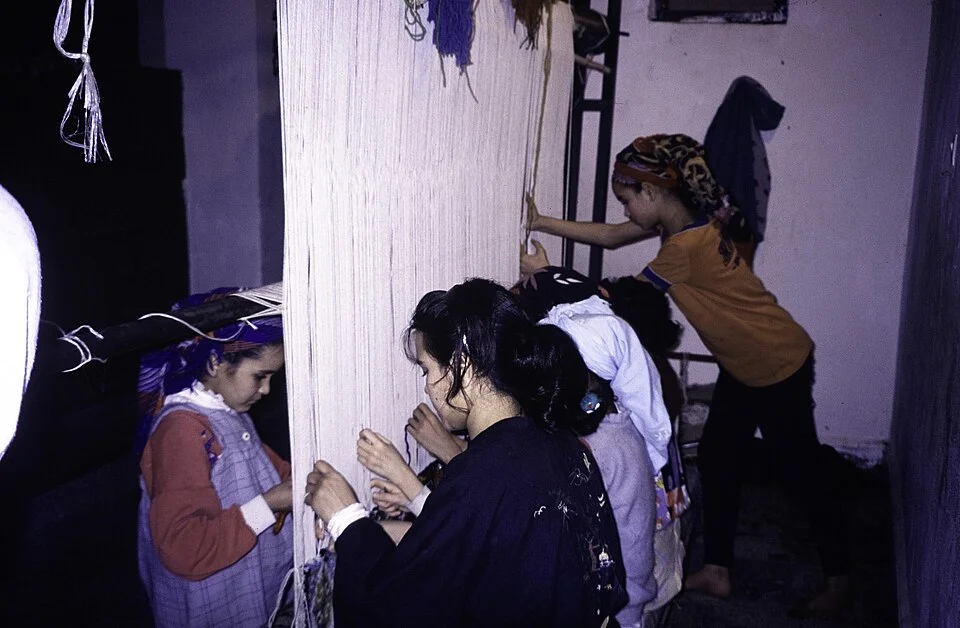
Later, when the light in the workshop had gone the particular gold it goes around four in the afternoon, the younger weaver knelt beside the finished lower band of the piece and ran her fingers across it very slowly. She was checking tension, feeling for any spot that was tighter or looser than its neighbours. It looked like tenderness. It also was tenderness, but the practical kind, the sort a doctor has for a patient she has been treating a long time.
We drove back down the mountain that evening with a slightly rearranged idea of what we were building. Our story page covers where the brand came from. This afternoon, though, is what it is actually made of, and what the craft page tries, in its own way, to show.